


, 6 min read
How to organize your family's medical records
One record per person, what a new doctor will ask for, and how to get copies from a doctor or hospital: who to call, how long they have, what it can cost.

Co-founder & CEO, Lifelong
Organize a family's medical records by person: one record each, holding the same short list, built from copies you ask each doctor and hospital for. Each provider keeps its own file and releases it by its own process, so the joined-up version is one the family builds.
What should each person's medical record contain?
Each person's medical record needs the same short list, whether it is for a child or a grandparent. MedlinePlus, from the US National Library of Medicine, suggests starting with:
- name, birth date, blood type and emergency contact information
- date of last physical
- dates and results of tests and screenings
- major illnesses and surgeries, with dates
- a list of medicines and supplements, the dosages, and how long they have been taken
- any allergies
- any chronic diseases
- any history of illnesses in the family
What will a new doctor ask you for?
A new doctor will want your medicines, your insurance details and the names of the other doctors you see. The National Institute on Aging says to take these to an appointment:
- a list of everything you take and the dose, or the medicines themselves in a bag
- your insurance cards
- the names and phone numbers of the other doctors you see
- your medical records, if the doctor doesn't already have them
For a first visit it adds your former doctors' names and addresses, and suggests asking for the medical history form in advance so you can fill it out at home.
How do you get copies of medical records from a doctor or hospital?
You get copies of your medical records by asking each provider that holds them. HealthIT.gov, the US government's guide to health records, says to check the provider's patient portal first, because some of what you need may already be there. If it isn't, call and ask for the health information services department, or the administrative staff in charge of releasing health records.
There is no official script for that call. This is my own wording:
I'd like a copy of my health record. Who handles record requests, is there a form, and can you send it electronically? What will it cost?
The form is usually called a medical record release form or a request for access. There is no standard version, but HealthIT.gov lists what most of them ask for:
- the patient's full name, date of birth and medical record number, if you know it
- the dates of the care you want records for
- which information you want, often as a set of check boxes
- how you want it delivered: a PDF by email, paper by mail, a health app
- a signature and date, and your relationship to the patient if you are not the patient
You can leave the "purpose of release" box blank. HealthIT.gov says the HIPAA Privacy Rule doesn't require you to give a reason to get your health record.
HealthIT.gov suggests asking for the full record when someone is changing their main doctor. Otherwise a partial record will do: allergies, medications, immunizations, test results, or the notes from a single visit.
How long does a provider have, and what can it cost?
A provider must act on your request within 30 days of receiving it. The rule allows one extension of up to 30 more days, and only if the provider tells you in writing why it is late and when it will finish. HealthIT.gov notes that some state laws set shorter timelines.
Any fee has to be reasonable and cost-based. The rule limits it to labor for copying, supplies for a paper copy or portable media, postage, and a summary if you agreed to one. HealthIT.gov says records delivered through a portal, an app or email will likely be free, and that you are entitled to your record even if you haven't paid your health care bills.
If a provider says HIPAA stops it from giving you your own record, HealthIT.gov's advice is to tell them the HIPAA Privacy Rule requires them to give you access.
How do you get a parent's medical records, or a child's?
A parent's medical records are your parent's to ask for. The request has to come from them, or from someone with legal authority to act for them. If your parent can sign, the simpler route is for them to make the request and share the copies with you.
HealthIT.gov says that if you are requesting records for someone other than your child, you may be required to provide a copy of the legal paperwork giving you that right. The Privacy Rule calls this person a personal representative: someone with authority under the law to make health care decisions for the patient. Ask the provider which documents it accepts.
A child's records are generally a parent's to request, with exceptions. Under the rule, a parent or guardian with legal authority to make health care decisions for a minor is generally the child's personal representative. The exceptions include care a minor can lawfully get without a parent's consent, and state law can widen or narrow a parent's access.
Vaccination records have their own process, covered in how to keep track of your child's vaccination records.
Paper, portal or app: where should the record live?
The record should live wherever the person who needs it can open it at eleven at night. Paper sits in one house. A patient portal shows only what that one provider holds, behind its own login. A shared app or folder works when everyone in the family keeps it current.
Families end up as the couriers of their own information: downloading PDFs, screenshotting results, forwarding them into group chats. Pick one place everyone looks first.
If that place is an app, read its privacy policy first. HealthIT.gov's checklist says to keep looking if an app has no privacy policy you can read, and that the policy should state the app won't use, sell or share your health information without your permission. We wrote separately about which laws apply to health apps.
Where does Lifelong fit?
Lifelong began as a record like this one: the shared record my co-founder Param Singh built of his grandmother's care in the last year of her life, so his family could prepare for each next step.
In Lifelong, each person has their own space for medications, conditions, symptoms, appointments and documents, and chooses what the rest of the family can see, one category at a time. You upload a file, a photograph or a scan. Lifelong reads it and places it on that person's timeline, and the details it pulls out are suggestions you confirm.
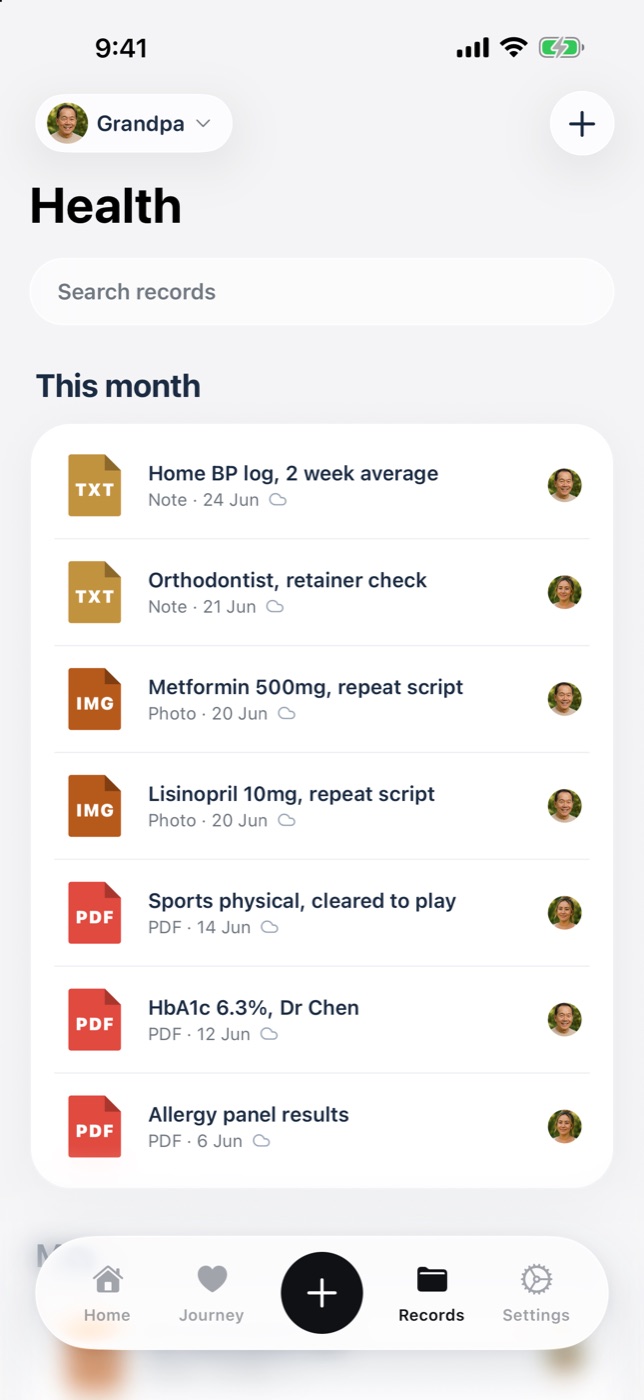
The copies you collect with the phone calls and forms above are what go in. Lifelong is on iPhone today, with Android coming soon. The FAQ covers keeping records for a child or for someone who doesn't use the app.
How do you keep a family's medical records up to date?
Keep a family's medical records up to date by filing each new document the day you get it. Photograph a new prescription, result or letter before you leave the parking lot. After a hospital stay, make sure you have the discharge summary, and check that a copy has gone to your regular doctor.
Read what you file. HealthIT.gov reports that nearly 1 in 10 people who check their online health record ask to have a mistake corrected, a figure from a 2017 US survey. If you find a mistake, ask the provider for its correction process.
Give each person's record one keeper, and make sure a second person knows where it is.
Ask for copies while the clinic is still there to ask. Practices close, merge and change record systems, and a copy is easier to get from a front desk that still exists.
Sources
- MedlinePlus: Personal health records
- National Institute on Aging: How to prepare for a doctor's appointment
- HealthIT.gov: The guide to getting and using your health records
- HealthIT.gov: How to get it
- HealthIT.gov: How to check it
- HealthIT.gov: How to use it
- ONC Data Brief No. 40: Individuals' use of online medical records and technology for health needs (April 2018)
- Code of Federal Regulations, 45 CFR 164.524: Access of individuals to protected health information
- Code of Federal Regulations, 45 CFR 164.502(g): Personal representatives
Lifelong is a health information tool, not medical care. Nothing here is medical advice; for a decision about someone’s health, talk to their doctor. Medical disclaimer.